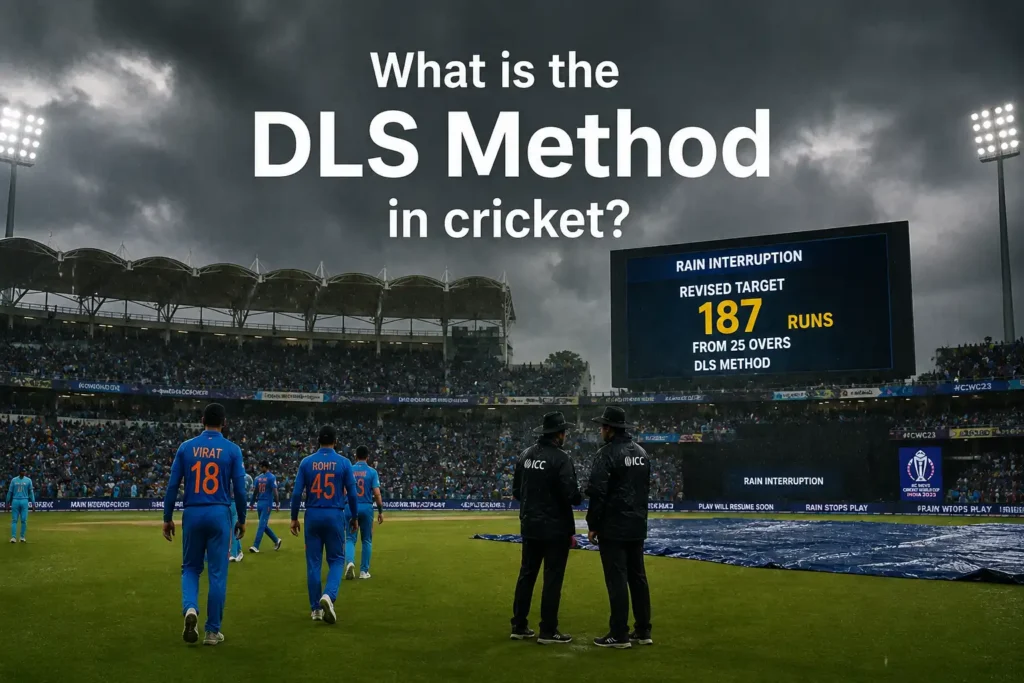
If you’ve ever watched a cricket match interrupted by rain, you’ve probably heard commentators mention the DLS Method. Many new cricket fans find this rule confusing because the target score suddenly changes after the match resumes.
In this complete guide, you’ll learn what the DLS Method is, why it is used, how it works, where it is applied, and why it is considered the fairest system for rain-affected matches.
Table of Contents
What is the DLS Method?
Full Form of DLS
Why Was the DLS Method Introduced?
When is the DLS Method Used?
How Does the DLS Method Work?
DLS in T20 Cricket
DLS in ODI Cricket
Simple Example of DLS
Advantages of the DLS Method
Limitations of the DLS Method
Famous Matches Decided by DLS
Frequently Asked Questions
Conclusion
What is the DLS Method?
The DLS Method is a mathematical system used to calculate a revised target in rain-affected limited-overs cricket matches.
Instead of simply reducing overs, the DLS Method considers the batting team’s available resources, such as:
Overs remaining
Wickets lost
Match situation
Scoring potential
This helps create a revised target that is as fair as possible for both teams.
What is the Full Form of DLS?
DLS stands for:
Duckworth–Lewis–Stern Method
The method is named after statisticians Frank Duckworth and Tony Lewis, while Professor Steven Stern later updated and improved the system.
Today, the International Cricket Council (ICC) officially uses the DLS Method in international limited-overs cricket.
Why Was the DLS Method Introduced?
Before the DLS Method, rain often produced unfair match results because targets were adjusted using very simple calculations.
The DLS Method was introduced to:
Make rain-affected matches fairer
Consider wickets as well as overs
Prevent teams from gaining an unfair advantage
Improve consistency in international cricket
When is the DLS Method Used?
The DLS Method is used only in limited-overs cricket, including:
T20 Internationals
One Day Internationals (ODIs)
ICC tournaments
IPL and many domestic leagues
It is not used in Test cricket.
How Does the DLS Method Work?
The DLS Method is based on the idea that every batting team has two main resources:
Overs remaining
Wickets in hand
A team with 20 overs left and 10 wickets has more scoring potential than a team with 20 overs left but only 4 wickets remaining.
When rain interrupts the match, the DLS system recalculates the available resources and sets a revised target.
The official calculations are performed using approved DLS software rather than manual arithmetic.
The DLS Method is a mathematical system used to calculate revised targets in rain-affected ODI and T20 matches.
What is the full form of DLS?
Duckworth–Lewis–Stern Method.
Is DLS used in Test cricket?
No. Test matches do not use the DLS Method.
Why is DLS considered fair?
It considers both overs remaining and wickets lost instead of reducing the target using a simple formula.
Who uses the DLS Method?
The International Cricket Council (ICC) and most major cricket boards use the DLS Method in limited-overs cricket.
Conclusion
The DLS Method in Cricket plays an important role in ensuring that rain-affected matches remain fair and competitive. While the calculations behind the system are complex, the basic idea is simple: both overs and wickets represent batting resources, and the revised target should reflect the resources available to each team.
Understanding the DLS Method helps cricket fans enjoy rain-interrupted matches with greater confidence and appreciation for the game’s rules.